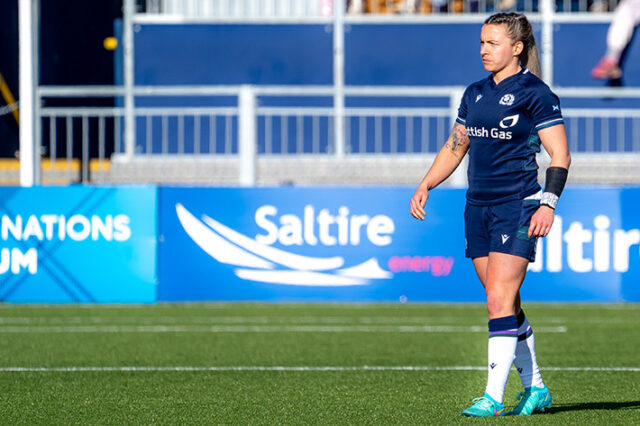


It was deja-vu as an increasingly depleted Scotland lost heavily to France. But they showed more fight and picked up a try bonus point to soften the blow. Here are some talking points.
Scotland’s depth tested yet again
Scotland’s injury horror story continued with Rachel McLalchlan, Alex Stewart and Lana Skeldon all missing from the team that played Italy, and Rachel Malcolm ruled out of the tournament. It meant that the entire back row were lock/back row hybrids, rather than specialists, and none of the three had worn that shirt number for Scotland before. Meanwhile, 21-year-old Glasgow hooker Aicha Sutcliffe made her debut from a bench that only had 45 caps between them.
This is the start of a World Cup cycle and for all that the injury problems have made this tournament close to a write-off, it is showing that there is a wider squad who can do a job, but also that there needs to be more players contracted so that when Scotland lose first choice players, they are turning to full-time professionals.
There were a lot of positives to pick out from the less experienced players. Rachel Phillips was excellent, and showed the value of picking a specialist centre. It was her first start, the fourth player to start at 13 in four games, but took her tries brilliantly, powerfully driving through the tackles and providing heft and power in both attack and defence. Becky Boyd had some of her best play for Scotland, proving her potential to be a real line-buster, and was Scotland’s second highest carrier. And Aicha Sutcliffe looked right at home, landing all her line out throws and taking her try brilliantly, as well as providing energy around the park, reacting quickly to a line out overthrow from France and adding some strong carries.
None of these players have contracts though; that needs to be rectified soon.
First quarter fight shows glimpses of promise
The game started like a nightmare for Scotland, as miscommunication at kick-off receipt (a curse for Scottish teams as we all know) led to a France try within 50 seconds. After that Scotland put together their best quarter since the Wales game, or possibly of the tournament. Their defence showed so much more energy that in the previous two games, with much better line speed and hustle, with the likes of Rhona Lloyd to the fore with some important pressure and interventions. This was allied with some incredible maul defence from the forwards and rips in the tackle to stop France’s attacking momentum.
In attack there was also a significant improvement, much quicker ball and much better accuracy, even with the odd mistake.
It wasn’t that France were playing poorly in this period either, there was some absolutely exhilarating attacking play from them (not least the skill from Carla Arbez to secure her try). But Scotland were causing their defence problems and their kicking game was also getting behind France and forcing them back, the cherry on top being a superb 50:22 from Leia Brebner-Holden which set up the first try.
Although the game got away from them after this (and the third quarter was a bit of a disaster), it did show that despite all the injuries and change, this team can still be competitive and has positives to build on.
Attack shows up well against the tournament’s best defence
Before this match, France had only conceded a total of three tries from their three matches; no team had scored twice against them. So it was quite the achievement for Scotland to get the try bonus point (and makes it a greater mystery that this is Scotland’s first of the tournament).
The two first half tries from Phillips were excellent from the team. For the first, it was an excellent line out and superb maul drive, to win penalty advantage. The ball came quickly to Meryl Smith who, not for the first time this tournament, deceived the defence by looking behind herself and passing flat. It was just enough to momentarily unsettle the defence and give Phillips the opportunity to power through, in what was a brilliant first try on her first start.
The second try had some similar ingredients. A good platform generated by quick ball and hard carrying by the forwards, before some excellent passing found just enough of a gap for Phillips to take advantage. This time it was two crisp, flat passes from Brebner-Holden and Helen Nelson that were too quick for the French defence to fully align, and Phillips again powered over through the defence brilliantly.
The final two tries came from well worked mauls. For the first, I’m still at a loss as to why a couple of backs didn’t join a strong maul and give it that extra push over the line, but thankfully the opportunity wasn’t lost. It nearly was lost again as Scotland created some space for the backs but some timings were just off and France scrambled well, but finally Emily Couborough did manage a powerful drive over the line for her debut try. The fourth try was second time lucky from a maul, the first after a brilliant kick to touch from Meryl Smith. Sutcliffe held her nerve brilliantly, steering the maul and darting down at the exact right time. Although these were only flashes, scoring one more try against France than Italy, Wales and Ireland had managed together is something to celebrate.
A depressingly familiar pattern unfolds
Scotland’s last two defeats to France felt very different to this one, meaning for all that the areas mentioned above had some positives and promise, it ultimately felt like a disappointing performance compared to those two previous games. Two years ago, Scotland were just three points behind going into the last couple of minutes after a performance of serious intensity and defensive brilliance. And although last year in La Rochelle was a comfortable 23-point win for France, 19 of those points came in a devastating 8-minute blitz. The rest of that game was a much closer contest.
There was a similar frustrating pattern to the previous games against England and Italy. The opposition scored at regular intervals meaning Scotland never really had a foothold in the match, or the ability to build any momentum.
France scored in under a minute in the first half, and under two in the second half. After three of the Scotland tries, France scored again within two minutes. For the other, it was after four minutes. They also conceded two tries whilst a player up, but scored none of their own, which followed on from scoring one and conceding one when Italy were down to 13 players.
It means that Scotland have conceded 33 tries already, one fewer in four matches than they conceded across the eight matches of 2025 Women’s Six Nations and World Cup pool stage added together last year. It’s a hard to diagnose exactly what is allowing opponents to score with such regularity, but two consistencies have been failing to slow the opposition ball down enough, and getting turned over frequently.
The latter stops so many Scotland attacks and momentum, and either allows for counter-attack ball or a big territory loss from a penalty concession. It is proving a worrying pattern, and probably the main thing they will be looking to fix as they go into a tough fixture away to Ireland in front of a huge crowd at Aviva Stadium.







1 response
26 – 0 down after 20min to Ireland. Has been very poor from Scotland this W6N.