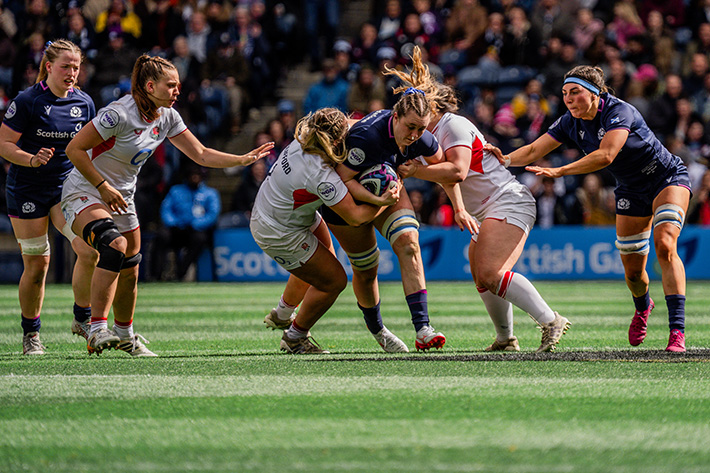


A historic occasion for Scotland went more than a little awry as the Red Roses found top gear and swept them away. Here are some talking points.
Regardless of the result, this was a special day
It really was gobsmacking being at the match and seeing how quickly the crowd has grown for this team in the last few years. It felt like it was 60-70% Scotland fans, and not just people coming to see the world champions.
It was also emotional and inspiring. Walking in after watching the u21s match, the queue for facepainting snaked back with well over 100 kids waiting. The queue for the team shop curled round a huge part of the stand.

There were people everywhere creating a festival atmosphere, bringing noise and joy – before, during and after the game. The women’s team and the team’s fans finally got the full Murrayfield experience – thousands greeting their arrival, the lone piper on the roof, the proper stadium acapella second verse of Flower of Scotland, and thousands of fans waiting in the stands after the game to cheer the team’s lap of honour.
The team will be disappointed their performance didn’t match the occasion, but this will always be the day they created history, with over 30,000 fans in the stands and hopefully the start of a new chapter.
Poor defence opens the gates for England
There is never any point comparing Scotland’s performance to England’s, given the gap at this point.
The disappointment was that this did not compare well to Scotland’s last match against the Red Roses in the Rugby World Cup quarter final, as they conceded twice as many tries in the match.
Although they never looked like winning that quarter final either, Scotland’s intensity felt much higher in Bristol last year. Most teams would struggle when England’s forwards like Maud Muir, Sadia Kabeya and Maddie Feunati are in such a rampaging mood, but the tackle percentage needs to be higher and the defence back in position quicker.
In their last three matches against England, Scotland had maintained a tackle percentage over 80%, in this game it dropped to 72% – well below their standards. It’s hard to know if some of this was down to learning a new defensive system from the coaches, with new players coming in, or if Scotland were just particularly missing defensive lynchpins such as Evie Gallagher and Emma Orr. But this will need to be addressed before facing the dangerous Italian back line.
England’s average ruck speed was a frankly preposterous 2 seconds – and that was when there was a ruck, with England also making 12 offloads. But Scotland faced quick ruck speed against both Canada and the Red Roses at the World Cup last year. It felt like they coped with that and reorganised their defence much more effectively, even if not with total success.
It is noticeable that Gallagher and Sarah Bonar were the two players to hit the most defensive rucks in last year’s Women’s Six Nations – despite playing less than 4 full matches. Gallagher hit nearly twice as many defensive rucks than any other teammate, as well as making a ridiculous 11 turnovers. Although I couldn’t find the equivalent stats for this year, the speed and effectiveness of England’s ruck suggests that a key work-on for the coaches will be trying to ensure other players are replicating Gallagher and Bonar’s workrate from last year to try slow the ball down.
When your defence is already stressed and struggling to reload quickly, the team does not need key injuries and players out of position to disrupt the system further.
It is notable that the last 7 tries went through after defensive organiser Evie Wills (in for Orr) went off and was replaced by a back three player at centre for the first time at international level, and the last five when a scrum half was playing on the wing and the starting hooker was at flanker (as was the case for the last 20 minutes).
Even allowing for this, Scotland were just too passive. Much was made about England missing some key forwards, but it they were replaced by international class players with a massive point to prove and who were taking their team to a new level of performance. Scotland need that same energy from their squad.
Lack of accuracy costs Scotland a platform
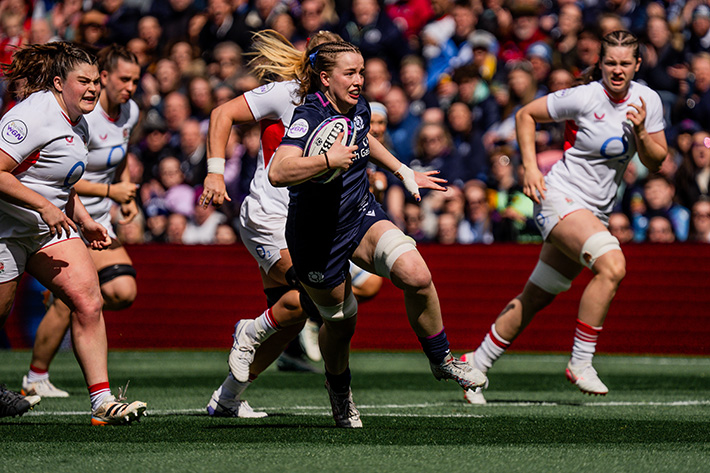
It is such a shame that Scotland’s excellence in the first couple of minutes, with a beautiful line from Emily Coubrough and some dominant carries from Lana Skeldon and Elliann Clarke, didn’t result in a try as an early score might have calmed Scotland and seen them trying to force things less in attack.
Instead, chances were few and far between.
Any time Scotland did build some momentum, it seemed a riskier pass or offload led to a knock on, or a lineout error cancelled out the good work from earning a penalty. The desperation also showed late in the first half when Scotland got a good rumble on at the maul but twice inside ten minutes mauled for too long and were wrapped up and turned over.
England were also winning the kicking battle, partly because Zoe Harrison was on sublime form, but also because Scotland lacked the execution shown the previous week against Wales. I’m pretty sure the missed kick to touch in the second half was partly the fault of an unfortunately-timed gust of wind (there genuinely was a strong gust hitting the East Stand just as the ball drifted the wrong way and I remember being ready to declare the wind my mortal enemy).
At the same time, there should be enough knowhow in the SRU about the Murrayfield wind to ensure the team were prepared to deal with that issue.
While kicks were landing exactly where intended last week (and perhaps bouncing better than intended), it was more of a mixed bag this week. There was some really good kicking from Scotland, but Emma Sing and Harrison didn’t allow there to be much advantage from it and usually Scotland lost territory from any kicking battle.
Shorter attacking kicks looked a smarter bet but the accuracy of last week wasn’t there – whereas Meryl Smith’s kick to Lucia Scott was perfect last week, she just missed the opportunity to put Francesca McGhie in space, and Helen Nelson had some uncharacteristic errors. Kicking as much as possible was clearly the plan.
Usually you’d expect to see Chloe Rollie attempt a couple of line busting runs when she took the ball deep, but I think she kicked every time.
Even Leia Brebner-Holden was box kicking – she had three kicks and I’d be surprised if she has kicked that many times across her whole career to date. But both because of England’s excellence, and some poor execution, Scotland weren’t gaining territory and were losing possession. Coupled with poor line outs in the best attacking positions, there was no platform for attack from either kicking or lineout.
Still small joys to celebrate
Although the scoreline was disappointing (and worsened by three late tries), there were still some positives to take from it. The scrum completely fell apart in the World Cup quarter final, but it held up much better and according to RugbyPass stats, Scotland had the higher scrum percentage of the two teams.
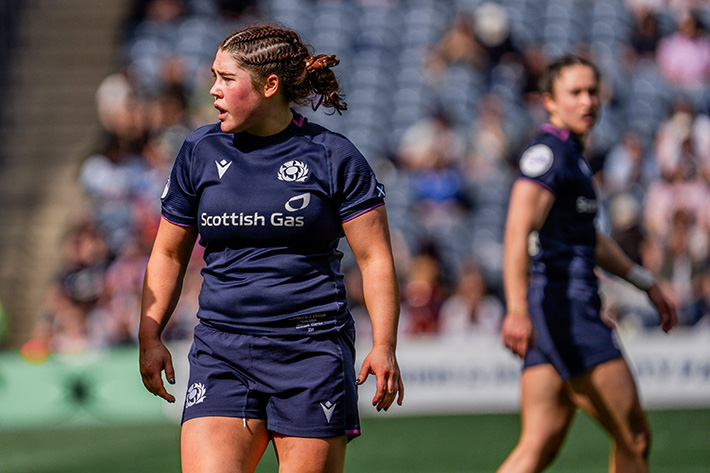
Clarke managed more than one carry that emulated her opposite number Muir and burst through some tackles, in one of her best carrying games in a Scotland shirt. Rianna Darroch missed out on a debut from the bench last week, but the 20-year-old did not look phased by her early introduction when Brebner-Holden went off for an HIA, and looked accurate and composed in both her appearances on the pitch.
Most importantly, Rhona Lloyd’s try was a beauty and gave the Scotland fans something to go wild for. Nelson quickly identified that Scotland weren’t getting go forward and switched up her tactics.
This was one kick that was absolutely perfect, and Rollie and Lloyd’s pace did the rest, with Jess Breach and Ellie Kildunne unable to stop Lloyd scoring her 30th try, going clear in second as Scotland women’s all-time top try scorer. It was wonderfully worked, inventive and accurate and showed what Scotland can do when they are at their best.
Hopefully the next time there is a big crowd for them at Murrayfield, they’ll be able to create several moments like that. But as much as the score was a disappointment, this match will be partly remembered for the sheer excellence of the Red Roses on the day, but most of all for the huge celebration of women’s rugby that a 30,000-strong crowd represents in Scotland.