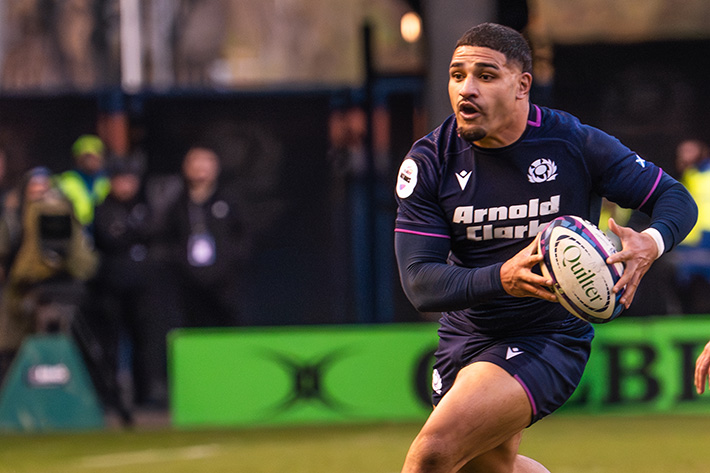
An improved performance from Scotland was not quite enough as they ended a highly frustrating 2026 with another loss. But this time they matched the Wallaroos with five tries apiece and their performance has much to build on. Here are some talking points.
Scotland give themselves a platform
In their previous two games, Australia had around 60% possession in both games and over 60% territory in each. This time that pattern was reversed with Scotland having 59% possession and 58% territory in their favour. Their phase play looked more fluent and connected, and they were making territory gains ball in hand and creating significantly more line breaks than previous – 14 in this game, as opposed to 7 and 5 in the previous two. Scotland looked more confident as a result and it did look like the team were finally starting to click again.
This was allied with a better performance at set piece, with a clean scrum and lineout, and just one lineout going awry directly. The driving maul was in impressive form, constantly making metres and creating scoring or break opportunities. Other teams might defend it a bit better, but it was good to see Scotland have such dominance in one aspect as it had to help build confidence and give them something to rely on when they need to get on top and get momentum in the game.
Mistakes undo the rebuilding job
Australia’s discipline was pretty terrible in the game – partly because of the pressure the Scottish attack was putting on their defence – and it definitely gave Scotland a route into the game. But Scotland once again had some frustrating passages where they didn’t capitalise on the opposition’s problems, their own platform, or the lead they had built at half time. Alongside the first ten minutes, the most frustrating period was the third quarter, where Scotland lost the game. At the start of the second half, Scotland briefly had a two-player, then one-player, advantage, but a few mistakes, including a yellow card for cynical play, cost them not only the player advantage but also the lead, leaving them down 11 points around 50 minutes.
But the worst was to follow. Scotland then played really well to get back with four points through a well-worked team attack that ultimately led to Rhona Lloyd’s try, and it felt like the momentum was with them.
But they tried to run it back from the restart, instead of clearing their lines, lost possession and then gave away a soft offside penalty to allow an easy three points for the excellent Samantha Wood. And then, as has proved a pattern this year, Australia scored another try with 35 seconds of the subsequent restart.
It seemed to be a mixture of defensive uncertainty and a couple of tackles falling off, and Australia had the speed and skill to capitalise and give themselves a lead that Scotland was ultimately unable to overturn. There was so much to like from this Scottish performance, and the team will be frustrated that a few key errors stopped them from achieving a first-ever win over the Wallaroos, when so much of their play was good enough for the victory.
Midfield conundrum
In the ongoing injury absence of Lisa Thomson and Emma Orr, the coaches have picked a few different midfield combinations. This one saw the biggest change, with Hannah Ramsay brought in at stand-off and Helen Nelson and Meryl Smith shifted out to 12 and 13 respectively.
It’s hard to give a full verdict on how it worked however, as despite the numbers on their backs, Nelson and Smith were almost always at first receiver, with Ramsay seeming to be around just in case, but mostly running dummy lines.
Leia Brebner-Holden seemed to be doing a lot of directing of traffic, alongside Nelson, so it wasn’t like Ramsay appeared to be sitting off to organise the attack instead. However, playing in the 13 shirt did seem to free up some aspects of Smith’s play, allowing her better angles to run on and still dish up her excellent distribution – but it’s not clear to what extent this was a tactical change, more than a positional one.
Ramsay’s defence was excellent and she certainly played her part in the performance through that. It does seem like the coaches know they have two players who can make a difference, alongside the control and accuracy of Nelson, but aren’t quite sure how to make them fit in the team yet.
I’m not sure we’ll see this combination again, but it does mean Scotland have two players who are adaptable starting or bench options, and who now both have experience at both stand-off, centre and full back but also able to come in at first receiver and create things, and as many options as possible can only be a good thing.
New generation continues to emerge
For all that it has been a frustrating year for Scotland, rebuilding after retirements and with several key players injured, it is good to see that the youngest generation can operate at this level. Holland Bogan (21) has been immense and her work rate second only to Evie Gallagher, and she may well be the first choice lock now, even when both Emma Wassell and Sarah Bonar are both fit.
They are not nailed down but when everyone is fit, it wouldn’t be a surprise to see Aicha Sutcliffe or Ceitidh Ainsworth (both 22) in the first choice 23. Molly Poolman and Alex Stewart (also both 22) have already established themselves as key squad players.
Katie Buchanan is 23 and could be challenging for a starting spot on the wing, even when everyone returns from injury. And two more youngsters joined the party in this match. Imogen Spence didn’t get much game time, but looked competent in the set piece and is only 19. And Nicole Flynn (21) finally made her Scotland debut and we will surely see her again soon, she played with confidence, made a couple of good line breaks and distributed well. There is such a turnaround from this stage of the last world cup cycle when often subs went unused or it felt like a big drop off in one of the first team had to go off injured. There is genuine depth, and a mix of youth and experience, in pretty much every position.
Scotland finish the year in an uncertain position
Scotland now find themselves in 10th in the rankings (though this could be back to 9th if Ireland beat South Africa at the weekend). They don’t have a permanent head coach at time of writing* and their next three matches are against Ireland, England and France, which will be extremely tricky.
They’re also on a run of nine losses. But they have been here before and were on a long losing streak in 2022, before winning seven in a row and gaining the WXV2 title the following year. If they can take confidence from an improved performance, they can get back in the winning habit again.
They also have a few key players to come back which will strengthen them further. It has been a bit of a year to forget, after a really good 2025 and reaching the quarter-finals of the World Cup.
Perhaps if they had been a bit more confident, they would have managed to find a way to victory in this game. The worry is that some things improved but at least one of the assistant coaches is temporary and returning to his club, and while hopefully Dave Butcher will stick around, we don’t know yet if that will be as head coach or assistant. The team deserve better than this uncertainty and hopefully a high class, permanent and motivated full coaching team will be in place soon.
* Forwards coach and Interim head coach Dave Butcher was announced as the permanent Head Coach today by the SRU. The SRU will soon begin the process of recruiting a full-time Assistant Coach (backs and attack) to join Butcher’s management staff, with Chris Laidlaw now joining permanently as Assistant Coach after his initial secondment during WXV. – Ed