



Preparations for the 2027 Men’s Rugby World Cup took a proper step forward today with the announcement of the six pools for the biggest edition of the tournament yet. The expanded 24-team format for Australia brings six pools of four and is meant to open the game up to more fans (where they need more fans).
From a Scotland point of view the first reaction is fairly predictable: of course we’ve drawn Ireland again.
Scotland land in Pool D with Ireland, Uruguay and Portugal. The two Tier 2 sides offer a decent chance to build momentum, but the whole thing still revolves around that familiar green brick wall. Ireland have dominated this fixture during Gregor Townsend’s time in charge (W0-L11), and Scotland have spent most of the past decade on the wrong end of the scoreline. The last win came back in 2017, and the meetings since have followed a fairly grim pattern. It has reached the stage where pulling Ireland out of a World Cup draw barely raises an eyebrow. It is simply what happens.
Still, it could have been a tougher draw and there is no South Africa this time at least. Uruguay showed plenty of spirit in 2023 and Portugal became everyone’s second team with some dazzling play of the sort we love around these parts, but Scotland should expect to handle both if they arrive with any kind of composure. That leaves Ireland – once again – as the hurdle that decides whether this World Cup has any meaningful depth to it or fizzles out early. Nothing new there.

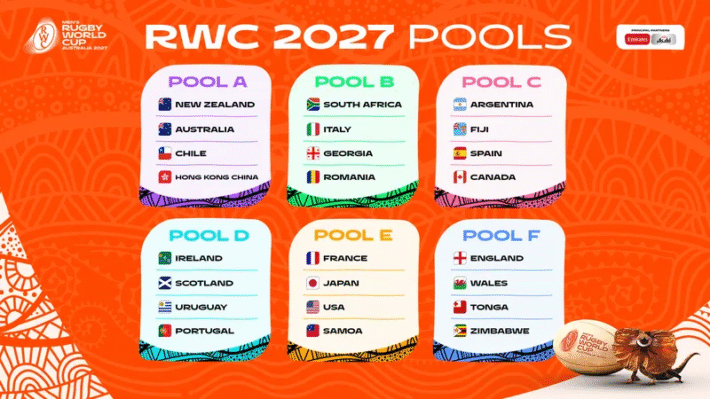
Across the rest of the tournament, Pool A brings together New Zealand, Australia, Chile and Hong Kong China for probably the ideal local derby for TV viewing to open the tournament. Pool B features South Africa, Italy, Georgia and Romania. Pool C has Argentina, Fiji, Spain and Canada. Pool E pairs France, Japan, USA and Samoa, while Pool F rolls out England, Wales, Tonga and Zimbabwe.
Wait, are we in the Pool of Death?
From Scotland’s angle, the pool offers a mix of promise and inevitability. The route is there, but so is the familiar sticking point. If Townsend is still in charge by 2027, which is currently not a given, it would finally require a performance against Ireland that breaks the cycle rather than repeats it. If someone else is wearing the head coaches jacket, they will inherit a task that has tripped up some of Scotland’s finest talents for generations multiple times, and to be fair our best coach of the professional era. Scotland will play Ireland twice before then in the Six Nations so next year’s clash in Dublin already has more importance.
Scotland know exactly what needs to be done. Whether they can actually do it is, as ever, the question.
For more news and information, including how to access tickets in the presale and secure your tickets, visit rugbyworldcup.com/2027.